The Hamptons has always sold more than square footage. It sells a lifestyle, a status symbol, and for many buyers, a bet on the future. But with median prices at record highs in 2026, the question on a lot of people’s minds is simple: is buying a house in the Hamptons still a smart move?
Most articles on this topic read like sales copy: buying a house in the Hamptons is about scarcity, prestige and “prices always go up.” Major news outlets like this New York Post article often cite that there is “no end in sight.”
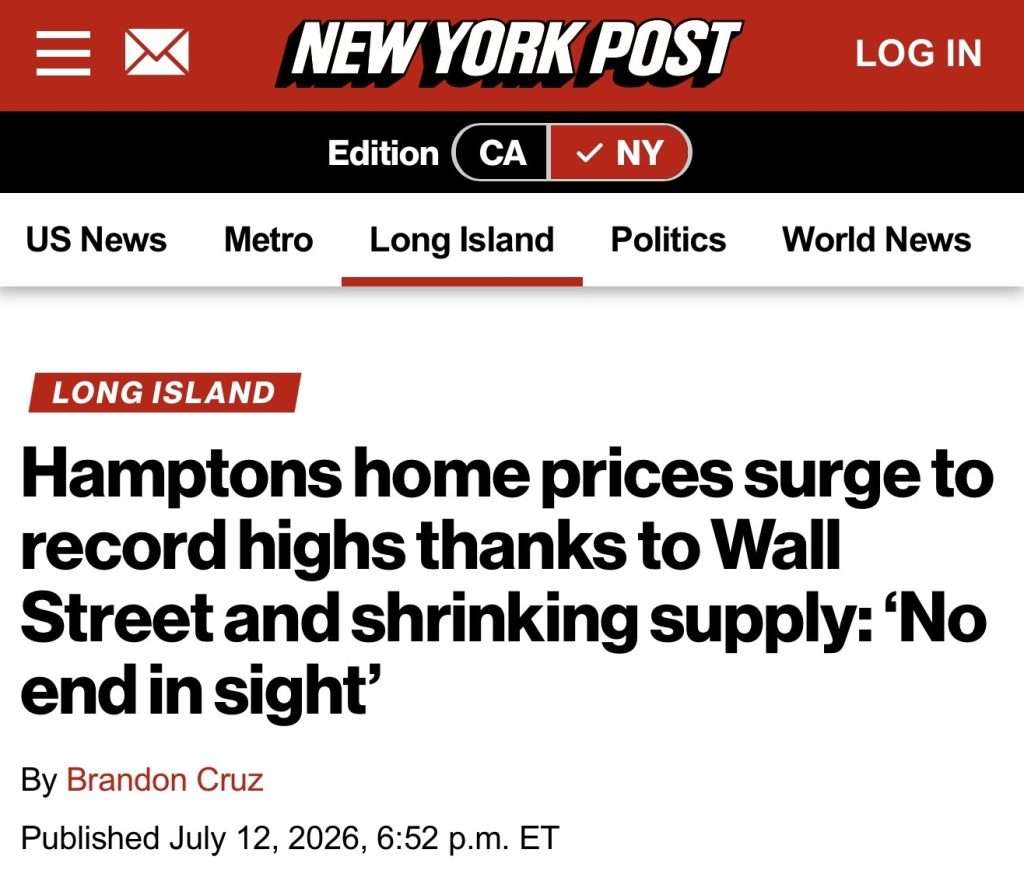
Although that is partially true, that’s not the full picture.
To actually answer the question, you need to look at three things honestly: how much prices have really appreciated, how much rental income realistically offsets ownership, and how much taxes, insurance, and upkeep quietly eat into both.
Where the Market Stands Right Now
Prices are near all-time highs. According to Out East (Source: Out East), the median and average sales price in the Hamptons hit a record $2.34 million and $4.25 million, respectively, in the second quarter of 2026, up 34% year-over-year, fueled in large part by strong Wall Street bonuses and a growing wave of hedge fund, private equity, and tech buyers moving east.
But here’s the detail that gets left out of most coverage: much of that jump isn’t pure price appreciation. It’s a shift in the mix of what’s selling. A greater share of total sales is coming from the biggest, most expensive homes, which pulls the median up even when individual homes aren’t gaining value at anywhere near that rate. This is something anyone seriously buying a house in the Hamptons needs to understand before drawing conclusions from the headlines.
In fact, in one recent stretch, homes in the top 10% of the Hamptons market actually saw average prices fall by nearly 12% year-over-year. That is not because demand dried up, but because more inventory came onto the market and reduced bidding wars. This reflects a shift toward higher-priced homes selling, not broad-based price appreciation.
Zoom out across the wider region and the picture is more moderate: over the twelve months ending June 2026, the median sale price came in at $1.85 million, up 19.4% from the year before. For those buying a house in the Hamptons, it is also worth noting that homes are also sitting on the market longer, about 118 days on average versus 105 days the year before, and fewer homes changed hands in May 2026 than in May 2025. That extra time on market is actually working in your favor as a buyer, giving you more room to negotiate than existed even a year ago.
In East Hampton specifically, the market actually tipped into buyer’s-market territory, a shift from the neutral conditions seen the year before. For anyone buying a house in the Hamptons right now, that is one of the most meaningful data points in this entire section.
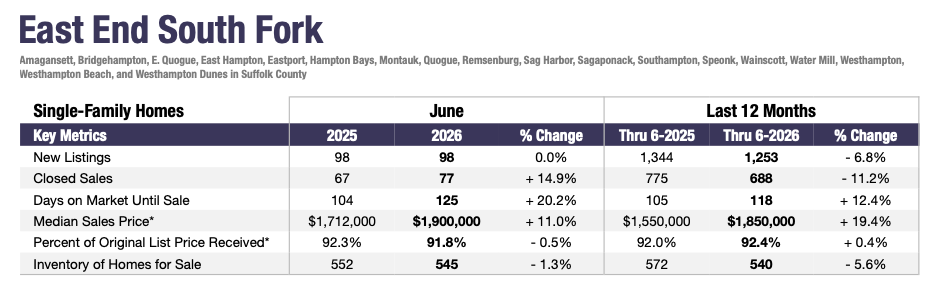
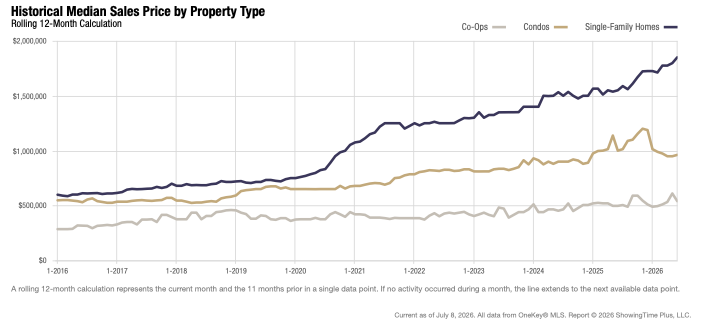
The honest takeaway: the Hamptons has appreciated meaningfully over the long run, and structural scarcity supports that continuing. But “median price up 34%” headlines overstate what a typical single home is actually gaining year to year, and the market is not uniformly hot – it’s increasingly bifurcated between the ultra-luxury tier and everything below it.
The Rental Income Reality
Summer rental income is the most-cited reason a Hamptons house “pays for itself.” It can help – but the range is enormous, and the current market favors renters more than it has in years.
Full-season rentals (Memorial Day to Labor Day) run roughly:
- Entry-level (Hampton Bays, Springs): $50,000–$75,000 for a modest three-bedroom without a pool
- Mid-market (Sag Harbor, Bridgehampton): $150,000–$225,000 for a four-bedroom with a pool
- Premium: (Southampton or East Hampton Village): $250,000–$500,000 for a turnkey home with amenities
- Trophy oceanfront: $900,000+ for the season, with a handful of estates commanding $2 million a month
Those headline numbers are seductive, but they describe the top of a wide range, not the typical outcome. Short-term rental platform data tells a more grounded story: the average active listing in East Hampton earned about $59,900 in revenue over the trailing twelve months, with 51% occupancy and an average nightly rate of roughly $1,500 on booked nights.
As for year-round rentals, according to Zillow, they actually run closer to $37,000 per month.
That’s real income, but it’s a fraction of the season-long headline figures – and it assumes an actively managed listing, not a home that sits empty most of the year.
It’s also worth noting the current supply glut. An estimated three-quarters of pandemic-era buyers are now choosing to rent their properties rather than sell, and summer rentals overall have been running well below their pandemic-era peak, with the steepest drops in the ultra-luxury segment. That means more competition for renters, more negotiating leverage on their side, and less pricing power for owners than the headline “$150,000 for the season” figures suggest.
Bottom line: rental income can meaningfully offset carrying costs on a well-located, well-managed property, but it’s not passive and it’s not guaranteed. Treat any pro forma that assumes full-season rental at asking price as a best case, not a baseline.
The Costs That Quietly Eat Your Return
This is the part sales-oriented content tends to skip, and it’s the part that determines whether you’re actually building wealth or just paying to enjoy a beautiful place.
Property taxes
Property taxes in the Hamptons are, by most local accounts, comparatively reasonable next to other high-end coastal markets – a genuine point in the region’s favor. But “reasonable relative to Malibu or the Jersey Shore” still means a real, five- or six-figure annual bill on a multimillion-dollar assessed home.
Buyers should also budget for New York’s closing-cost layer: the region’s Peconic Bay community preservation tax (about 2.5%) and the state’s mansion tax (1% on homes over $1 million) are non-negotiable costs due at purchase, not just holding costs down the road.
Insurance
Insurance is the cost most likely to surprise someone buying a house in the Hamptons. Nationally, insurance premiums have surged 48% over the past five years, and coastal metro areas are hit hardest.
Hidden ownership costs (insurance, maintenance, and property tax combined) already exceed $24,000 a year for a typical homeowner in the New York metro area, well above the national average of roughly $16,000.
Coastal-specific underwriting makes this worse: homes near the shoreline routinely face rating tiers that push premiums well above inland properties, driven by wind exposure, flood-zone designation, and the accelerated wear that salt air causes to roofs and mechanical systems.
Standard homeowners insurance also doesn’t cover flood damage – a separate policy is required, and it’s an easy gap for a new buyer to miss. This is consistent with the roughly one-quarter of Hamptons properties carrying meaningful flood risk over the next 30 years, a risk that’s growing faster than the national average.
Upkeep
Upkeep on a large property is its own line item most buyers underestimate. Full-service landscape maintenance – irrigation, lawn care, tree pruning, tick and pest control – typically runs $2,000 to $5,000 a month for a one- to two-acre property in season.
Pools, outdoor kitchens, and the kind of amenities that make a home rentable at premium rates carry their own maintenance and eventual replacement costs on top of that. None of this includes the general rule of thumb that homeowners should budget 1% to 3% of a home’s value annually for maintenance – a figure that scales quickly on a multimillion-dollar property.
Put together, taxes, insurance, and upkeep on a Hamptons home are a materially larger annual drag than on a comparable inland property, and they’re rising faster than incomes nationally. Any return calculation that doesn’t net these out against both appreciation and rental income isn’t a real number.
The Case For Buying
Land scarcity is a real, structural advantage
The Hamptons is a finite stretch of coastline hemmed in by conservation land and strict zoning. That kind of scarcity has historically been one of the strongest long-term drivers of real estate appreciation, and it isn’t going away.
The market is maturing beyond “just a summer place”
A growing share of buyers (about 50%) now treat Hamptons homes as year-round primary residences for New York City families, not just vacation properties. That is a shift that helps sustain demand beyond the old boom-and-bust rental cycle. It is also one of the reasons buying a house in the Hamptons makes more long-term sense today than it did even a decade ago.
Rental income is real
A well-located, well-managed property in the right hamlet can generate meaningful income, particularly in the $1M–$5M sweet spot where roughly 55% of Hamptons sales occur.
Property taxes are relatively favorable for this price bracket
Compared to other high-end coastal markets, taxes here are considered reasonable, which somewhat offsets the region’s higher insurance and upkeep costs.
The Case For Caution
Headline appreciation overstates typical gains
A rising median doesn’t mean every home, or even most homes, are appreciating at that rate. Much of the recent jump reflects a shift toward more high-end sales, not broad price growth, and the top 10% of the market has recently seen average prices decline.
Rental income has a wide floor-to-ceiling gap
Season-long headline rents in the hundreds of thousands describe premium properties in a landlord’s market; typical short-term rental revenue is closer to $60,000 a year, and today’s oversupplied rental market favors tenants.
Carrying costs are high and rising faster than income
Insurance premiums are climbing nationally at nearly double the pace of household income growth, coastal underwriting adds a real premium on top of that, and landscape and property upkeep for large estate lots runs into the tens of thousands annually.
This is not a quick-flip market
In today’s market, buying a house in the Hamptons is essentially playing a five- to ten-year game, not a short-term trade. You need a genuine long-term horizon and a cash cushion for slower years, not just enough capital to close.
“The Hamptons” isn’t one market
Value swings enormously by hamlet, by proximity to the ocean, and by whether a property sits north or south of the highway. Treating the region as a single, uniform market is one of the easiest ways to misjudge a deal.
So, Is Buying a House in the Hamptons a Good Investment?
Buying a house in the Hamptons is not as easy and straightforward as it may seem. Run the full math and the picture is more nuanced than either the boosters or the skeptics suggest. Long-term appreciation has been real, driven by genuine land scarcity, but recent headline gains partly reflect a shift toward bigger, pricier sales rather than uniform appreciation.
Rental income can meaningfully help, but the reliable, average outcome looks a lot more modest than the season-long numbers that get quoted in glossy write-ups. And taxes, insurance, and upkeep are a real, rising drag that a lot of buyers underestimate until the first full year of ownership bills arrive.
If you’re evaluating this purely as a financial asset, the honest answer is: it can work, but only if you underwrite it like a real investment, with realistic rental assumptions, real insurance quotes for the specific property (not regional averages), and a genuine multi-year hold, rather than penciling in the best-case numbers from a listing brochure.
If lifestyle and personal enjoyment are part of the equation, the calculation shifts, because you’re also paying for years of use that don’t show up on a spreadsheet and that’s a legitimate reason to buy even if the pure numbers are unspectacular.
Either way, buying a house in the Hamptons isn’t a decision to make on vibes and headlines. Get a real insurance quote before you make an offer, ask for the seller’s actual utility and maintenance costs, and model the deal assuming flat prices for five years (not continued appreciation) to see if it still makes sense.