
Finding a good investment property is not an easy job. Stepping into the world of investment properties for the first time can feel like a lot – there’s no shortage of decisions to navigate.
A smart investment starts with clear eyes and careful research at every step. This guide will walk you through what to look for (and what to watch out for) when evaluating a potential good investment property.
What to Look for When Choosing a Good Investment Property
Solid Rental Demand and Location
Choosing a property in an area where renters want to live is one of the best ways to minimize vacancies and keep income flowing consistently.
Signs of a strong rental market include a high concentration of renters in the area, low unemployment, rising rent prices, and properties that don’t stay on the market for long.
To get a clearer picture of any market, tap into resources like real estate listing platforms, public records, local government reports, and MLS databases. Your broker will be a great resource to have by your side here.
Market Appreciation
Investing in neighborhoods that are on the rise can make it easier to attract and keep quality tenants. Key indicators to watch for include expanding local industries, strong job growth, and active infrastructure development in the area.
For instance, new schools, hospitals, or public transportation projects are often signs that a community is growing – and where growth goes, rental demand tends to follow.
New York has consistently been at the top in this regard, with researchers consistently ranking it as one of the hottest real estate markets in the country.
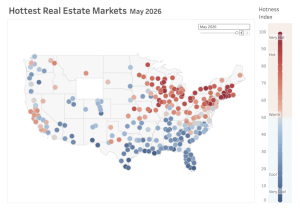
Source: Realtor.com Economics Research
High ROI and Cap Rate
Price alone shouldn’t drive your decision when evaluating an investment property. What matters just as much is the return you can realistically expect.
A strong Return On Investment (ROI) not only means better profits, but also gives you a cushion to handle the inevitable challenges of property ownership.
One of the most useful tools for measuring expected returns is the capitalization rate, or cap rate. To calculate it, divide your Net Operating Income (NOI) (what’s left after subtracting expenses from your projected rental income) by the property’s current market value.
The result is a percentage that reflects your expected rate of return. For example, if a property is valued at $800,000 and your NOI is $60,000, your cap rate works out to 7.5%.
Most investors target a cap rate somewhere between 4% and 8% or higher. Just keep in mind that a higher cap rate signals greater potential returns, but also greater risk.
New York residential cap rates generally range between 3.5% and 7.5%, heavily depending on the borough and property class.
Prime Manhattan luxury assets trade at lower cap rates (3.5%–4.5%), while older walk-ups in the outer boroughs can hit 6.5% to 7.5%. Citywide averages rest in the mid-5% to 7% range.
Long Island ranges from 5.5% for premium assets to 8% for older inventory.
Strong Tenant Appeal
A great location can only take you so far. If the property itself doesn’t appeal to renters, filling vacancies will be an uphill battle. Before making a decision, walk through the property with a tenant’s eyes.
Ask yourself the practical questions: Is there plenty of natural light? Is laundry available on-site? Is storage adequate? Is parking convenient and accessible?
The surrounding neighborhood matters just as much as the unit itself. Beyond safety, consider what’s nearby – public transportation, parks, grocery stores, and restaurants can all be deciding factors for prospective tenants.
If you’re not sure what today’s renters are looking for, browse current rental listings in the area to get a sense of what the competition is offering.
Minimal Maintenance Requirements
A well-maintained property is a huge advantage for investors. When evaluating a home, take a close look at its major systems and overall condition – not just how it looks on the surface.
If the roof is nearing the end of its lifespan, for instance, that replacement cost needs to be factored into your numbers. The same goes for the age of the HVAC system and the condition of exterior finishes, which can be expensive to repair or replace.
What to Watch Out for When Choosing a Good Investment Property
Finding a property with strong long-term income potential is a cornerstone of building your real estate portfolio, but knowing what not to do is just as valuable as knowing what to look for.
Here are five pitfalls that trip up many investors:
Overlooking Local Rental Demand
If there aren’t enough renters in the area, your property could sit empty and drain your income instead of generating it.
Not Knowing Local Landlord-Tenant Laws
Certain areas (including HOA-governed communities) may restrict your ability to rent the property out at all, or restrict your ability to raise rents by more than a certain percentage each year.
Skipping the Home Inspection
What you don’t know can hurt you. Hidden issues discovered after closing can turn into costly surprises.
Underestimating Renovation and Repair Costs
Surprise expenses can quietly erode your returns before you ever see a profit.
Letting Emotions Drive the Decision
If you fall in love with a property, it’s easy to skip the hard numbers – and the ROI may not hold up under scrutiny.
Final Thoughts
Choosing a good investment property comes down to doing your homework and keeping emotions out of the equation. The best opportunities are found in markets with strong rental demand, growth potential, and numbers that actually work – from cap rate to maintenance costs and tenant appeal.
Just as important is knowing where investors commonly go wrong. Skipping inspections, underestimating costs, and overlooking local laws can quietly turn a promising property into a costly mistake.
Whether you’re buying your first investment property or adding to an existing portfolio, the fundamentals remain the same: research the market, run the numbers, and think like a tenant. Do that consistently, and you’ll be well-positioned to build a portfolio that generates steady income for years to come.