
Every buyer knows to budget for a down payment. Fewer know that in New York City, the gap between the purchase price and what you actually wire at closing (assuming all cash) can run 3% to 6% higher due to hidden closing costs.
The closing costs that catch people off guard usually aren’t the ones on the closing cost sheet everyone talks about.
The One That Ambushes New Development Buyers: Sponsor-Paid Transfer Taxes
Everyone budgets for the mansion tax. Almost no one reads far enough into a sponsor’s offering plan to find the line that shifts the NYC and NYS transfer taxes (normally a seller expense) onto the buyer.
In a typical resale, the seller eats that cost. In a sponsor sale, it’s routinely written into the offering plan that the buyer absorbs it, adding roughly 1.825% (or 2.075% on deals at $3M+) on top of everything else. (Source: NYS Senate)

On a $2 million sponsor unit, that’s an extra $36,500 that never shows up in the sticker price. This hidden closing cost is the single biggest reason two “identical” $2M listings (one resale, one new development) can have wildly different true costs.
The fix isn’t complicated, but it requires knowing to look: some sponsors will negotiate the concession away on units that have been sitting on the market, though almost none offer it on day one of a launch.
The Mansion Tax “Cliff” Nobody Explains
Most buyers know the mansion tax exists. Fewer understand it’s a cliff, not a bracket. Originally meant for luxury properties, now this hidden closing cost affecting many regular apartments (Source: NYT).
The rate applies to the entire purchase price the moment you cross a threshold, not just the amount above it. Cross from $1,999,999 to $2,000,000 and the rate jumps from 1% to 1.25% on the whole price, not just the extra dollar. That is a $5,000 swing for one dollar of purchase price. (Source: tax.ny.gov)
The base mansion tax is 1% for a purchase price between $1,000,000 and $1,999,999. Below are the supplemental tax rates:
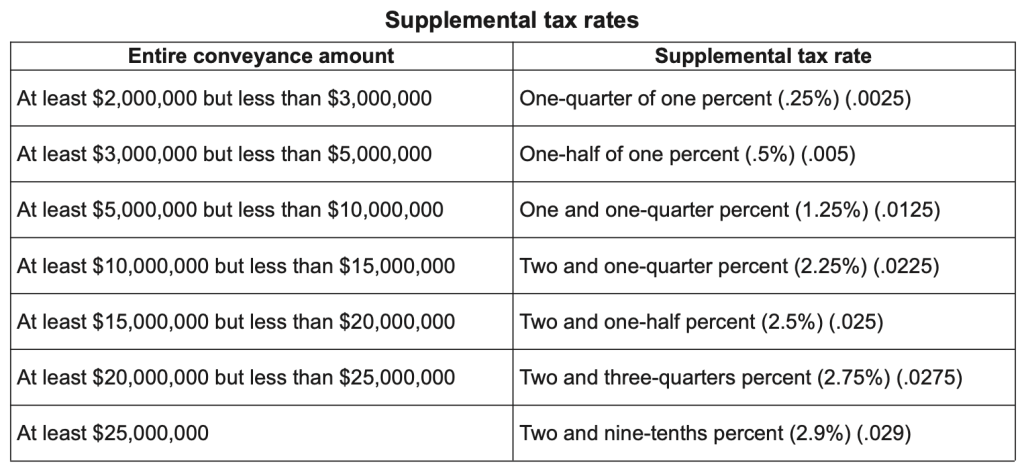
That’s why so many negotiations quietly land just under a round number, and why a good broker is doing this math before an offer goes in, not after.
The Mortgage Recording Tax (And the Workaround Few Buyers Hear About)
On any financed condo purchase, buyers pay a mortgage recording tax of 1.8% to 1.925% of the loan amount.

This is one of the largest single hidden closing costs in the city, and one many first-time NYC buyers have literally never heard of until they see it on the settlement statement. On a $1.2 million loan, that’s over $23,000.
Co-op buyers dodge it entirely, since a co-op purchase is technically not real property, but rather shares in a corporation. This is one of several reasons co-ops and condos have meaningfully different cost structures.
For refinances, a CEMA (Consolidation, Extension, and Modification Agreement) can save $5,000–$20,000 by taxing only the difference between the old and new loan amounts, but it only works if your attorney knows to structure it that way from the start.
For purchases, in a CEMA, the buyer takes over or “assigns” a seller’s remaining mortgage balance instead of the seller completely paying it off. The buyer’s new lender combines that assigned balance with additional funds needed to cover the purchase price.
The Co-op Specific Traps: Flip Taxes and the Building’s Own Fees
Co-op sellers, not buyers, typically pay the flip tax, which is usually 1% to 3% of the sale price, set by each individual building’s bylaws.
Some boards shift it to the buyer by house rule, and it’s easy to miss this hidden closing cost buried in the proprietary lease.
On top of that, co-op buyers face application and move-in fees, and often a requirement to hold two years of post-closing liquidity in reserves – a cash requirement that has quietly killed more than a few deals at the eleventh hour.
The Working Capital Fund/Contribution
New-development buyers are often asked to fund a building’s “working capital fund” at closing.
This hidden closing costs are commonly two months of non-refundable common charges, essentially seed money for the building’s operating account.
It’s standard, disclosed in the offering plan, and still catches buyers off guard because it doesn’t look or feel like a tax; it looks like an arbitrary fee tacked on at the closing table.
Title Insurance and the Small Print of a Condo Purchase
Condo buyers (not co-op buyers, who skip this) typically pay roughly 0.5% for an owner’s title policy plus another 0.2% for the lender’s policy if financing – plus search and recording fees that add up fast on higher-value deals and are rarely mentioned until the attorney sends the final numbers.
Other More Common Line Items
Property Tax Reassessment Lag
NYC assesses based on income approach for condos/co-ops, which can create a gap between what a buyer expects to pay annually and the actual bill once the unit is reassessed post-sale (not immediately thereafter, but in the medium-term).
Board Package Costs for Co-ops
Application fees, credit check fees, and sometimes a non-refundable processing fee just to apply, before you even know if you’re approved.
Move-in/Move-out Deposits
Many buildings charge $500–$1,500 refundable deposits that buyers forget to budget for and then forget to reclaim.
Homeowners/Co-op Insurance
Often a full year prepaid, due at the closing table.
Adjustments & Prorations
Common charges, real estate taxes, pre-paid assessments and fuel (in older buildings outside of Manhattan) prorated as of closing date, which can be another hidden closing cost worth a few thousand dollars either direction depending on timing.
The Bottom Line
None of these hidden closing costs are exactly secret. They’re all disclosed somewhere in a contract, an offering plan, or a building’s bylaws. But “disclosed” and “understood before closing” are two very different things.
The buyers who avoid sticker shock are the ones who understand the hidden closing costs and get a real closing-cost estimate (sponsor terms, building-specific fees, etc.) before they make an offer, not after they’ve gone into contract.
On a purchase this size, that’s not extra due diligence. It’s the difference between budgeting correctly and writing a much bigger check than you expected, or sinking the deal altogether.